| 人类最杰出的伟人,伟人最朴素的陵墓(组图) | 2012-06-13 19:52:01 | | |
| 老高的博客 | | |
| | “印刷匠本·富兰克林的遗体长眠于此。他象一本旧书的封面,内容被撕去,字母与烫金已经脱落,只能躺在这里供昆虫吞噬。但他的著作不会全部丧失,那些著作就像他所期待,所相信的那样,重新修订后将会以崭新的、更加完美的版本再次问世。”美国国父之一本杰明·富兰克林在费城的陵墓给人启发良多
若问“世界上你最敬佩谁?”答案一定形形色色。从切·格瓦拉、海伦·凯勒,到本·拉登、萨达姆·侯赛因,都有自己的大批粉丝。像薄熙来说他最敬佩秦始皇和毛泽东,他将与他们鼎足而三——这是传言,未必能当真。
我敬佩的人太多了,要指出一位“最”,还真是难题。本杰明·富兰克林,无疑名列前三甲。
我居住的新泽西这一带,到处都是冠以富兰克林的镇、街道、公园,最为人熟知的,就是架在德拉瓦河上,连接费城和坎顿的本杰明·富兰克林大桥,足见美国人对这位先贤的景仰;而他创立的常春藤盟校之一的宾州大学,也近在咫尺。
本杰明·富兰克林本人,就安眠在费城市中心第五大道美国宪法中心附近。
墓地始建于1719年,占地面积两英亩,安葬了4000多基督教教会会员,其中包括本杰明·富兰克林在内的五位美国独立宣言的签署者,还包括一些做出杰出贡献的著名人士:美国海军缔造者和多位将军,有著名律师,医生,生物学家,物理学家,独立战争中的英雄,也有不少死于流行病的普通教会成员。
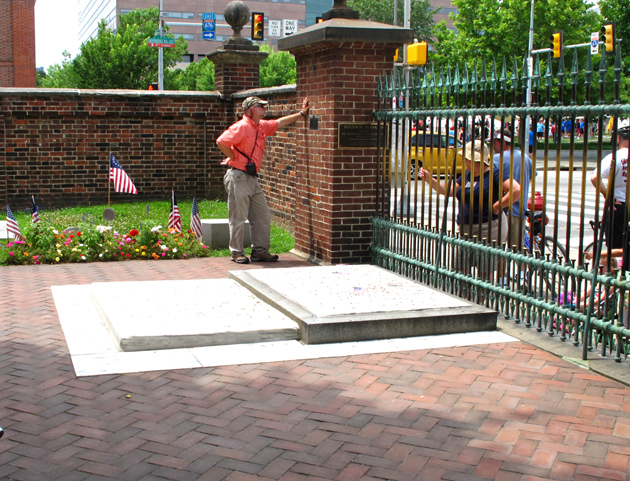
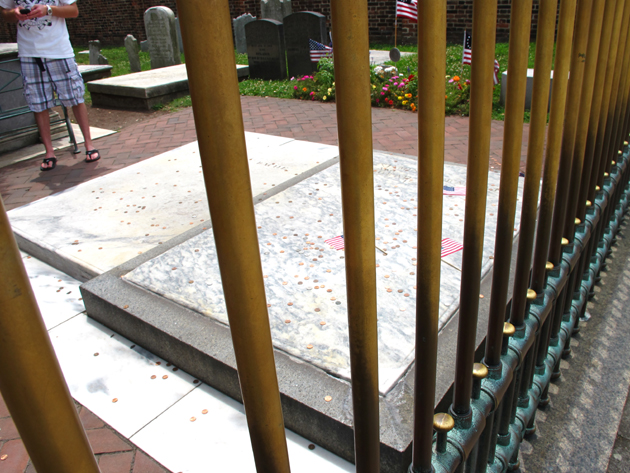
本杰明·富兰克林墓,是我看到的人类伟人、名人中最朴素的陵墓。且不说列宁陵、毛泽东纪念堂这些独裁者的葬身之地了,就在美国,杰斐逊纪念堂、林肯纪念堂、罗斯福纪念馆、马丁路德金墓……都何等巍然。而弗兰克林墓,竟然就在这里仅仅占地数平方米!
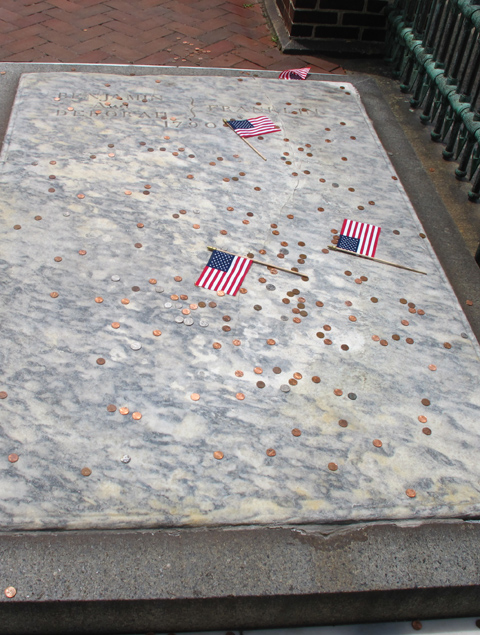
他的墓地像一本打开的书,墓碑上简单地写着他和他妻子的姓名:Benjamin and Deborah Franklin,1790
富兰克林1790年去世后,被安葬在墓地西北角的家族墓地,与妻子德博拉和两个孩子合葬在一起。1858年,富兰克林的子孙要求用金属栅栏取代砖墙,以便瞻仰者能够方便看到富兰克林的墓地。他的安眠之处的外面,就是大马路,车水马龙,市井喧嚣。
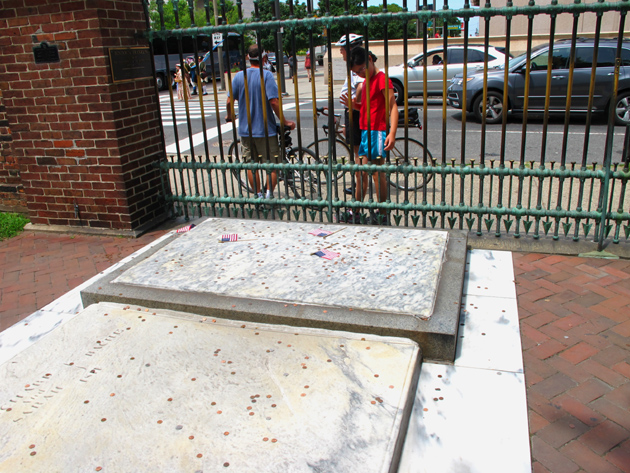
从栅栏外的人行道上果然能够方便看到富兰克林墓。
美国第一任总统华盛顿曾说:“在我的一生中,能让我佩服的人只有三位,第一位是富兰克林,第二位也是富兰克林,第三位还是富兰克林。”富兰克林竟然让华盛顿如此推崇!
本杰明·富兰克林(1706~1790)是美国堪称“全才”的人物。他的头衔和贡献,是很难罗列穷尽的:思想家、政治家、外交家、科学家、实业家、发明家、慈善家,还是出版商、印刷商、记者、作家……他与杰斐逊一起起草了美国《独立宣言》,与华盛顿一起领导美国独立革命,是美利坚合众国的国父之一。他没有当过美国的总统,只当过联邦邮政部长(有人中译为邮政总局局长)、驻法国大使和宾州州长等,但他与华盛顿、杰斐逊等人,当之无愧地足以并肩而立,许多方面的成就,超乎他们之上。他是唯一一位参与签署立国之四大文件者:《独立宣言》、《美法同盟条约》、《巴黎和约》、《美国宪法》……
出生于波士顿的富兰克林,不是“官二代”,也不是“富二代”,丰富的学识和深厚的修养,全靠终生好学不倦、自强不息。他自学了法语、西班牙语、意大利语、拉丁语;他的名字与许多“第一”联系在一起。我从小学就知道,他冒着生命危险做试验,发明了避雷针;他还发明了双焦点眼镜、新式火炉、蛙鞋和新型路灯等等,甚至还有导尿管!难怪他被选为英国皇家学会院士。
他的发明还包括社会创新,如“让爱传出去”(paying forward);他创立了美国第一所图书馆(1731年),第一支队志愿消防队(1736年),第一所医院(1751年)……就像杰斐逊创办了弗吉尼亚大学一样,富兰克林是宾州大学的创办人(顺便说一句,《独立宣言》签字者中9位、美国宪法签署者中11位,与该校有关);他还创办发行了影响巨大的《宾夕法尼亚报》;他更写出了一部美国迄今为止读者最多、全球最有影响的传记《富兰克林自传:富兰克林告诉年轻人的绝顶智慧经验》。这部作品本身就创造了很多“第一”:第一部自助式的书籍、第一部畅销书、第一部真正美国人的自传……
《富兰克林自传》有很多中文译本,其中一位中译者刘云波在译后记中写道:
“假如你是一个领导人而不知道该如何成为真正的人民公仆,那就请你读读《富兰克林自传》;假如你是一个商人而不知道该如何使自己生意兴旺发达,那就请你读读《富兰克林自传》;假如你是一个刚刚涉世的青年而不知道该如何迈好人生的第一步,那就请你读读《富兰克林自传》;假如你已为人父或为人母而不知道该如何教育自己的子女,那就请你读读《富兰克林自传》;假如你已步入生命的暮年而不知道该如何保持晚节,那就请你读读《富兰克林自传》。它能为你解答所有这些问题,它能引导你走上成功之路。”
看到富兰克林的生平和成就,真不禁要吟诵莎士比亚对人的赞美:
“人类是一件多么了不起的杰作!多么高贵的理性!多么伟大的力量!多么优美的仪表!多么文雅的举动!在行为上多么像一个天使!在智慧上多么像一个天神!宇宙的精华!万物的灵长!……”
富兰克林是人不是神。尽管他是一个出色的公职人员,也曾因为以权力替亲人谋求晋升,使他的公务生涯蒙上污点。我以前也不大知道的是,富兰克林还曾经当过“反革命”——在美国革命爆发以前,他强烈反对革命。只是在英国不可能在美洲殖民地维持统治下去,他才转而坚定地支持独立运动。
值得一提的是,2005年,AOL和Discovery联合筹办一个电视节目《最伟大的美国人》,列出美国历史上有较大影响力的人物,征集数百万名观众票选。富兰克林名列第五。不过,我把前十名的名单一看,不由得跌破眼镜:参加票选的美国人,也太不靠谱了吧!
1,罗纳德·里根,第40任美国总统
2,亚伯拉罕·林肯,第16任美国总统
3,马丁·路德·金,人权活动家
4,乔治·华盛顿,美国首任总统
5,本杰明·富兰克林,美国作家,发明家,政治家,科学家
6,乔治·W·布什,第43任美国总统
7,比尔·克林顿,第42任美国总统
8,艾维斯·普利斯莱(猫王),歌手
9,奥普拉·温芙瑞,著名脱口秀主持人
10,小富兰克林·罗斯福,第32任美国总统
里根总统名列“最伟大的美国人”第一名,而紧跟着本杰明·富兰克林的,竟然是小布什和克林顿!
不过,富兰克林本人,或许一笑置之。他对自己的这成就那成就,都不在意,他自己用以面对世界的头衔,是“印刷匠”(printer)。
我读中学时读到过一位哲人的话,可惜忘了是谁说的了:一个人的成就是分子,他对自己的评价是分母。分母越大,分数的值越小(大意)。富兰克林本人的无比谦逊,正是他在我心目中无比高大的原因之一。
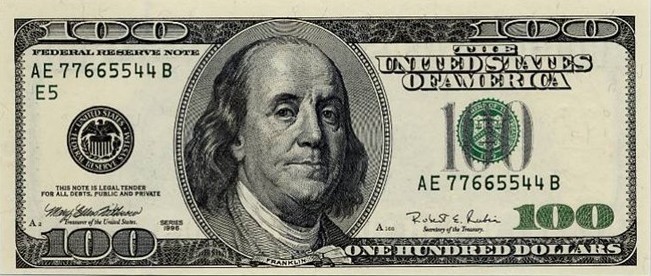
但是富兰克林本人生前有句名言:“节省一分钱等于赚了一分钱。”很多参观他的墓的人都会放下一分硬币。据称人们在这里留下的一分硬币,每年总计约三千美元,全部用于墓地的维护。
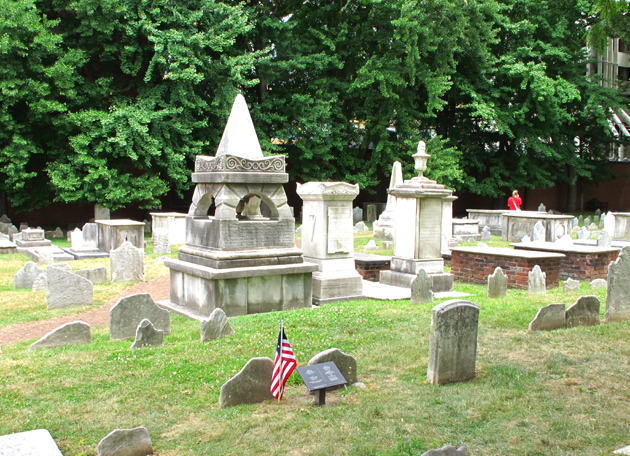
这座安葬了众多美国缔造者的墓园,堪称美国最重要的墓园之一,却那么朴实无华。所有墓碑都按照字母顺序排列,丝毫没有因为某个人身份显赫就占据某个特殊位置。经过数百年风雨侵蚀,墓碑上铭文都已经漫漶不清了。
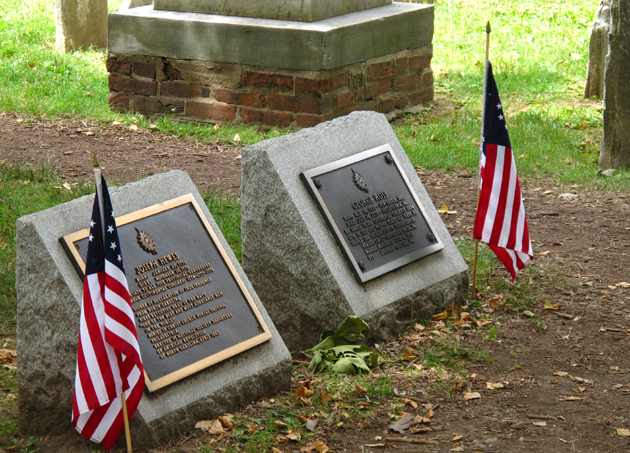
这两座墓的墓主看来也是当年的重要人物。
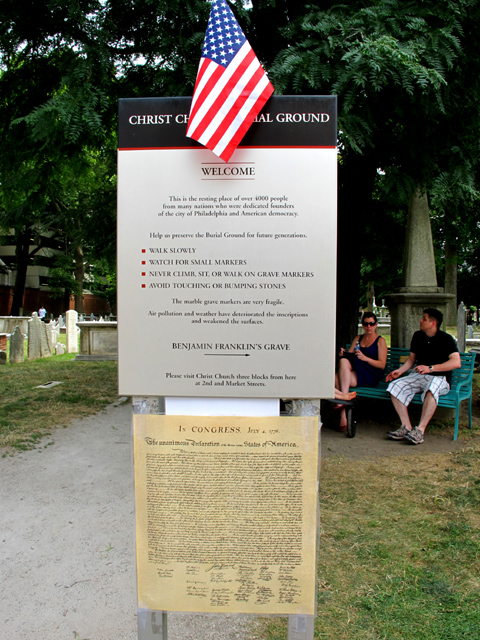
墓园门口就有富兰克林墓的指示牌。
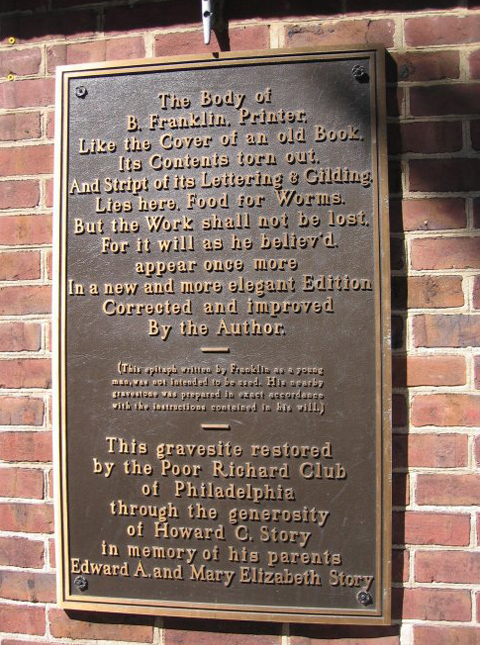
墓地旁边的院墙上,铜牌钉着富兰克林22岁时写的一段话作为墓志铭:
The Body of 这个躯体
B. Franklin 本·富兰克林
Printer 印刷工
Like the Cover of an old Book 就像一本旧书的封面
Its Contents torn out 内容
And stript of its Lettering and Gilding 字迹斑驳,镀金脱落
Lies here, Food for Worms 躺在这里,被昆虫吞噬
But the Work shall not be whlly lost: 但是他的工作不会消失:
For it will, as he believ'd, appear once more, 就像他所期待,所相信的那样,再次出现
In a new & more perfect Edition 以新的更完美的版本
Corrected and improved 订正和改进
By the Author 被作者
(最后几行,只能按行直译了。我抄下的版本,排列和个别字句与铭牌上的不完全相同)
| |
最安全和最不安全的十大国家
昔日的苏联,中国人学习的榜样,今天以低得可怜的平均寿命、政治腐败,和世界上最不安全的十大国家之一,而“苟延残喘”地存在着。标榜为人类谋福利的共产党国家的北朝鲜的上榜,就不用我来做评论了。朝鲜政治家们必然有自己“必须”那样做的理由,而美国人和生活在西方自由世界的人,也自然有自己看不惯的道理。只是,最终可怜了那些生活在凌辱状态下而不自知的部分人类了。命运不同,带来的就是不一样的人生。不管你相信不相信。
比较善于理财和“来事”的犹太人国家以色列,则是因为“生不逢地”,而不得不继续过着不安稳的日子。以色列人面临的处境,估计会永远的伴随他们,而难以获得明显的改善。当你有一个不想丢弃前嫌的邻居,你能够做的最好选择,恐怕就是远离。可惜,作为国家,你无法想搬就搬的。
世界上最安全的国家,都属于发达经济体之列。
人穷志短,看来,就是元恒不变的“真理”。穷人就是喜欢折腾,你再怎么期待,结果似乎也很难理想。世界大同,共同富裕和享受的日子,看来是永远也不会到来。上帝造人类之时,好像真的就造了一个自我毁灭的内在机制在里面了。
只是不能理解的是:为什么,就有那么些国家和地区,会有小部分人为了自己个人和小团体利益,而“斤斤计较”,而大动干戈,结果是自己和自己过不去。人类的理性,好像远没有经济学家所估计的那样来得“理性”。
对于贫穷和“喜欢”战争的国家与地区领导者的行为分析,看来,已经有的经济学理论,也不是很好用。理论的价值,好像还是有很大的地区性适应问题。人和人,在不同的环境,还真的是不一样。环境改变人,也造就了不同的人。
如果说,日本成为世界上最安全的十大国家之一,是因为日本人讲究团队合作,讲究顾大局,而中国人不上榜是因为自己喜欢“窝里斗”的话,那么,毗邻美国的加拿大的上榜和美国自己的落榜,则是得让美国佬好好三思的问题了。
美国的问题,真的是出在种族多元化这点上吗?还是另有其它的原因?
加拿大能,为什么我们美国佬就不能呢?怎么样才变得能呢?
The Most (and Least) Peaceful Countries in the World
June 15, 2012 by 247wallst
In 2011, world peace improved for the first time in three years. Incidents of terrorism fell and the global economic downturn decreased violence by reducing the amount countries spent on military budgets. However, while many parts of the world improved, others got worse as the result of rising commodity costs, increased protests and internal conflicts.
Recently, The Institute for Economics and Peace released the sixth edition of their annual Global Peace Index. The report examines 158 third-world, developing and developed nations around the world based on 23 separate indicators that, combined, measure the relative level of internal and external conflict in a country.
According to the report, “peace is notoriously difficult to define,” but in its most basic form it is “harmony achieved by the absence of war or conflict.” According to the IEP, those countries that can avoid military or diplomatic conflict with other nations and maintain stability and safety within their own borders are peaceful.
The 23 components that comprise the Global Peace Index, or GPI, are broken into two categories. Internal conflicts, which accounted for 60% of the total score, included measures of criminality, violent demonstrations and terrorism in each country, as well as the presence of violent internal political conflicts. According chairman and founder of the IEP, Steve Killelae, “Internal indicators measure the internal peace of a nation. So to describe a perfect nation, there would be no crime, no one in jail, and no need for police. The most peaceful nation would have the least of all three.” The other category, external peace, included military capability, the importing and exporting of weapons, and diplomatic relations with bordering nations.
According to the report, the most peaceful nations in the world are primarily in Europe, including several Scandinavian countries. New Zealand, Japan and Canada are also among the most peaceful. The countries with the greatest levels of external and internal violence are primarily in Africa, Eastern Europe and the tumultuous Middle East.
Of the components that make up the index, some were much more likely to correspond with high levels of peace or the lack of peace than others. Countries with easy access to small arms were much more likely to be violent. The most violent countries in the world, including Iraq, Somalia and Afghanistan, are all rated by the Economist Intelligence Unit as having the greatest access to small arms.
The level of political terror in a country is also a major indicator for overall violence there, according to the report. Of the countries with the highest GPI score, all have among the highest levels of politically sponsored oppression, which comes in the form of imprisoning and murdering dissidents. The worst in this category include countries like the Sudan, the Democratic Republic of Congo and North Korea, all of which are scored as the least peaceful in the world. The countries with the highest peace ratings, including New Zealand and Canada, all have the lowest possible levels of political terrorism.
The IEP also considers several socioeconomic factors that are not themselves part of the rank, but that they measured as possible drivers of violence and peace. The data suggests that while a country’s GDP, adult literacy and unemployment do not appear to have a strong impact on peace, others appear to be directly related. The presence of civil liberties and freedom of the press have much closer relationships to peace, according to the report.
The clearest among these are political factors such as corruption. According Killelae, the relationship between corruption and the lack of peace is profound: Slight increases in corruption do not appear to affect slight increases in peace, but he says that once a tipping point is reached peace “just disappears.” While the IEP is not exactly sure why corruption is such a powerful indicator, Killelae suggests that it is near perfect measure of “just how well functioning the level of government is.”
According Transparency International’s measure, which IEP also considered, all but one of the most peaceful countries in the report has very low levels of corruption. Most of the least peaceful countries, including Somalia, Sudan and North Korea, have among the highest levels of corruption.
The Institute for Economics and Peace compiled more than 50 separate sets of data from a variety of sources, including the Economist Intelligence Unit, the World Bank, UNESCO, the World Economic Forum and Transparency International to measure aspects of peace. Using IEP’s original sources, 24/7 Wall St. reproduced data for the factors the report determined to have the strongest correlations nationally to the 23 measures of peace. Most of the measures, including the political terror scale, access to small arms, relations with neighboring countries, and likelihood of violent demonstrations, are on a scale of 1 to 5, with 5 representing the least peaceful and 1 the most peaceful.
These are the most- and least-peaceful countries in the world.
The Most Peaceful Countries
10) Switzerland
> GPI: 1.349
> Political terror scale: 1
> Access to small arms: 2
> Relations with neighboring countries: 1
> Likelihood of violent demonstrations: 1
The Swiss maintain an open political culture and a well-functioning government, according to IEP. Illustrating the quality of Switzerland’s government, the country received the lowest possible score for political instability. While famed for its neutrality in global, international and regional political issues, Switzerland maintains strong relations with other nations in its region. However, the country has compulsory military service and exports more weapons, relative to its size, than any country in Europe.
9) Finland
> GPI: 1.348
> Political terror scale: 1
> Access to small arms: 2
> Relations with neighboring countries: 1
> Likelihood of violent demonstrations: 2
Since at least 2007, Finland has been among the 10 most peaceful countries ranked by the IEP, falling slightly from its rank of seventh last year. According to the report, this is due to improvement in the levels of peace in other countries rather than any declines in Finland itself. The state has a policy of strategic neutrality, and it is one of the few countries in the region to opt out of applying for NATO membership. The state scores very well across the board for measures of democracy, including freedom of the press, freedom of speech and the effectiveness of democracy.
8) Slovenia
> GPI: 1.330
> Political terror scale: 1
> Access to small arms: 1
> Relations with neighboring countries: 2
> Likelihood of violent demonstrations: 2
Slovenia was ranked the most peaceful of the 29 nations in Central and Eastern Europe. Explaining Slovenia’s ranking, the IEP cites low levels of violent crimes, a low proportion of the population in jail and an extremely low homicide rate. Though many of the countries formerly constituting Yugoslavia have struggled to maintain peace and adequate human rights, according the U.S. Department of State, “Slovenia has made great progress in establishing democratic institution [and] enshrining respect for human rights.”
7) Ireland
> GPI: 1.328
> Political terror scale: 1
> Access to small arms: 2
> Relations with neighboring countries: 1
> Likelihood of violent demonstrations: 2
Although Ireland is typically in the top 10 rankings for the most peaceful countries, in 2009 and 2011 it dropped out because of “economic and political crises,” the IEP explains. Ireland reentered the top 10 in 2012 by reducing its military expenditure to just 1.2% of its gross domestic product and by increasing its political stability, which has far-reaching effects on internal peace. Unlike most of the other peaceful countries, Ireland has slightly elevated levels of organized internal conflict. This is due to disputes between parts of the Protestant Unionist community and parts of the Catholic Nationalist community.
6) Austria
> GPI: 1.328
> Political terror scale: 1.5
> Access to small arms: 2
> Relations with neighboring countries: 1
> Likelihood of violent demonstrations: 2
Austria ranked as the third-most peaceful country in Europe, due in part to minimal violence and political conflict within the country. Austria’s equitable distribution of income may be partially responsible for the absence of such conflicts. The country maintains warm ties with neighboring nations. According the U.S. State Department, Austria has also been active in “bridge-building to the East” by maintaining close ties to Eastern European countries. And the country spends just 0.6% of its GDP on its military and has low violent crime and homicide rates.
5) Japan
> GPI: 1.326
> Political terror scale: 1.5
> Access to small arms: 1
> Relations with neighboring countries: 3
> Likelihood of violent demonstrations: 1
According to the IEP, Japan is the second-most peaceful of the 25 nations in the Asia Pacific region, behind only New Zealand. The country has little internal conflict, and firearms are difficult to come by. However, Amnesty International chastised Japan for its capital punishment program, which carries out the clandestine hanging of prisoners without their foreknowledge. Additionally, Japan maintains frigid relations with some of its neighbors, the most important being China. However, Japan’s overall positive GPI score is supported by the nation’s responses to issues such as nuclear armament.
4) Canada
> GPI: 1.317
> Political terror scale: 1
> Access to small arms: 2
> Relations with neighboring countries: 1.5
> Likelihood of violent demonstrations: 2
Canada has been in the top 10 most peaceful countries in the world for four out of the past six years, only dropping out in 2008 and 2010 when the number of soldier fatalities in Afghanistan increased. The biggest strike against Canada’s peace score is that it has a relatively high military capability and sophistication, even though it presently is not involved in any conflict. Overall however, Canada has good relations with neighboring countries and is part of the North American Free Trade Agreement. Canadians enjoy some of the world’s highest levels of civil liberties, including freedom of the press, trade unions and freedom to protest.
3) New Zealand (tied for 2nd)
> GPI: 1.239
> Political terror scale: 1
> Access to small arms: 1
> Relations with neighboring countries: 1
> Likelihood of violent demonstrations: 1
Every year since 2007, the IEP has ranked New Zealand as one of the world’s five most peaceful. This year, New Zealand tied with Denmark as the second-most peaceful of the 158 countries studied. A small proportion of its population in jail, limited military capacity and sophistication, and strong relations with Australia all help its score. New Zealand receives the best score possible on the Cignarelli and Richards (CIRI) Political Terror Scale. New Zealand also received the highest score in Amnesty International’s Corruption Perceptions Index, indicating there is little suspicion of corruption in the country.
2) Denmark (tied for 2nd)
> GPI: 1.239
> Political terror scale: 1
> Access to small arms: 1
> Relations with neighboring countries: 1
> Likelihood of violent demonstrations: 1
Denmark moved up two places this year, due in part to government budget cuts that decreased military spending, according to the IEP. The biggest strike Denmark has against its level of peace is the moderate sophistication and capabilities of its military. Denmark has the world’s smallest Gini coefficient — 24.7 — which means the country has a high level of income equality. With extremely low levels of violent crime and conflict, paired with political democracy and equality, the Danish enjoy a very high level of general peace. Denmark also has a notably high level of freedom of speech and freedom of the press.
1) Iceland
> GPI: 1.113
> Political terror scale: 1
> Access to small arms: 1
> Relations with neighboring countries: 1
> Likelihood of violent demonstrations: 1
Iceland, a country with only about 320,000 residents, takes the top honors for the most peaceful country for the second year in a row. The small country recorded the best possible score on all but four of the criteria that determine levels of peace, including the best scores on the homicide rate, imports of major conventional weapons and the likelihood of violent demonstrations. Ironically, Iceland’s continued fiscal belt-tightening helped the country lower its score from last year. The Icelandic Defense Agency, which had a budget of $20 million in 2008, now has been disbanded, according to the IEP. The country has no standing army, and military expenses total just over 1% of GDP.
The Least Peaceful Countries
10) Pakistan
> GPI: 2.833
> Political terror scale: 5
> Access to small arms: 4
> Relations with neighboring countries: 4
> Likelihood of violent demonstrations: 4
The highest GPI indicator for Pakistan is the political terror scale — the most highly correlated internal indicator for less peaceful countries. Pakistan received the highest rating possible under this scale, which means that the country’s leaders have “no limits on the thoroughness with which they pursue personal or ideological goals.” The entire population experiences political violence, terror and integrity rights violations, based on the CIRI Human Rights Data Project’s scoring criteria. Pakistan received one of the worst possible scores for its relations with neighboring countries, due in large part to its border conflict with India over a portion of the Kashmir region, a conflict that has persisted since 1947.
9) Israel
> GPI: 2.842
> Political terror scale: 4
> Access to small arms: 3
> Relations with neighboring countries: 4
> Likelihood of violent demonstrations: 3
Peace continues to be a problem in Israel, even though its ranking has decreased in the past three years. The most pressing issues are its political terror scale and relations with neighboring countries, both of which have a 4 out of 5, nearly the worst possible score. That means that a large part of the population experiences political violence and that Israel has open conflicts with neighboring countries. According to the IEP, “Israel remains in a formal ‘state of war’ with its northern neighbours, Syria and Lebanon, and relations with much of the Arab world and Iran remained highly strained.” Paired with this conflict, Israel has the least peaceful score for heavy weapons and military capability.
8) Central African Republic
> GPI: 2.872
> Political terror scale: 4.5
> Relations with neighboring countries: 3
> Likelihood of violent demonstrations: 3
In the Central African Republic, easy access to small arms and a high level of organized internal conflict, represented by scores of 5 and 4 respectively, are two of the largest impediments to peace. This conflict is largely due to the Lord’s Resistance Army (LRA), a rebel group that attacks villages, abducts people and has become infamous for creating child soldiers. The Central African Armed Forces, the country’s national military, has been relatively ineffective in protecting citizens from rebel group attacks and has contributed to human rights violations. The country also had a perceived criminality score of 5, the worst score possible. According to the IEP, citizens of a country receiving that score are “living in constant fear of violence between groups.”
7) North Korea
> GPI: 2.932
> Political terror scale: 5
> Access to small arms: 4
> Relations with neighboring countries: 5
> Likelihood of violent demonstrations: 1
Political terror is highly present in North Korea, which has had a tripling in the number of public executions this year, following the succession of Kim Jong-il by his son, Kim Jong-un. The sinking of a South Korean naval vessel has exacerbated North Korea’s poor relations with its southern neighbor, almost bringing the two nations to war. The country is also heavily militarized, spending an estimated 20% of GDP on its military — the highest such figure in the world. North Korea likely views this as necessary in order to maintain its missile program and its demilitarized zone. The country also is especially corrupt, even apart from the authoritarian ruling of the Kims. From the 1970s through the 2000s, numerous government officials were arrested for trafficking in drugs abroad.
6) Russia
> GPI: 2.938
> Political terror scale: 4
> Access to small arms: 4
> Relations with neighboring countries: 3
> Likelihood of violent demonstrations: 3
The high levels of political terror and perceived corruption mean that many Russians experience human rights violations and are aware of corruption in the current administration. According to Transparency International, government censorship, low levels of officials following the rule of law, and very little control over corruption make Russia one of the most corrupt countries in the world. Also contributing to low levels of peace is that Russia engages in open conflict with the North Caucasus region, including parts of Georgia and Russian territories like Dagestan and Chechnya. According to the IEP, the ethnically diverse Caucasus region is subject to high levels of violence and ambushes against local authorities, but there is still a moderate level of organized internal conflict in the country because other regions are relatively peaceful.
5) Democratic Republic of the Congo
> GPI: 3.073
> Political terror scale: 5
> Access to small arms: 5
> Relations with neighboring countries: 3
> Likelihood of violent demonstrations: 5
The GPI score for the Democratic Republic of the Congo (DRC) has increased each year since 2008. The deterioration of this peacefulness was due to an increasingly high likelihood of violent demonstrations preceding the presidential election and an unsuccessful coup attempt in Kinshasa, the DRC’s largest city. Human Rights Watch has accused the national military of committing atrocities against citizens, including the murder of more than 100 civilians in 2009. The military also has engaged in conflict with the Democratic Forces for the Liberation of Rwanda (FDLR) and the LRA, rebel groups known for their violence and human rights violations that have sought refuge in the DRC. Perhaps most tragically, the country has the world’s second-highest infant mortality rate, with 111.7 infant deaths for every 1,000 live births.
4) Iraq
> GPI: 3.192
> Political terror scale: 4.5
> Access to small arms: 5
> Relations with neighboring countries: 2
> Likelihood of violent demonstrations: 4
In 2012, Iraq became the least peaceful country in the Middle East, the IEP’s least peaceful region. With the body count at 4,087 civilian deaths this past year, the Iraqi people are subject to high levels of political terror and atrocities from organized internal conflict. Iraq also has one of the most dysfunctional governments in the world and has a high level of perceived corruption. Last December, Tariq al-Hashemi, Iraq’s vice president and most senior Sunni Arab politician, was arrested for allegedly funding attacks against the government. Opponents of Prime Minister Nouri al-Maliki accused him of using the judicial process against al-Hashemi to consolidate power. As a positive, many Iraqis were able to return home in 2011, reducing the number of refugees and internally displaced people to 9.4% of the population.
3) Sudan
> GPI: 3.193
> Political terror scale: 5
> Access to small arms: 5
> Relations with neighboring countries: 4
> Likelihood of violent demonstrations: 4
According to the IEP, refugees and internally displaced persons accounted for 10.5% of the population of Sudan, worse than all countries except Afghanistan, Bhutan, Cyprus, Iraq and Somalia. The Sudanese government has been accused of assisting janjawid militants and several other groups in Darfur, while simultaneously combating the Sudan People’s Liberation Army/Movement-North in the country’s South Kordofan and Blue Nile regions. Further violent disputes have arisen with the new nation of South Sudan over the Abeyi province. Additionally, the country was given the worst possible score by the IEP for ease of access to small arms and light weapons. In 2009, the International Criminal Court in The Hague issued an arrest warrant for President Omar al-Bashir, alleging war crimes.
2) Afghanistan
> GPI: 3.252
> Political terror scale: 4.5
> Access to small arms: 5
> Relations with neighboring countries: 3
> Likelihood of violent demonstrations: 4
In 2011, according to the United Nations, 3,021 Afghani civilians were killed as a Taliban-led insurgency has grown more active and violent. The high level of domestic conflict in Afghanistan has turned 3 million people into either refugees or internally displaced people. Ongoing domestic conflicts likely have done considerable damage to Afghanistan’s economy as well. At $506 per person per year, the country’s GDP per capita is lower than all but five of the 158 countries studied by the IEP. On June 14th, the 2,000th death in the U.S.’s Operation Enduring Freedom was recorded.
1) Somalia
> GPI: 3.392
> Political terror scale: 4.5
> Access to small arms: 5
> Relations with neighboring countries: 5
> Likelihood of violent demonstrations: 5
The war-torn nation of Somalia has been dubbed “the world’s worst humanitarian disaster” by the UN. The country has “not had a nationally functioning state government since its descent into civil war in 1991,” according to the IEP. And there has been violent confrontation between Islamist rebel groups in an effort to gain power. The power struggle between the warlords, specifically the Hizbul Islam and Al-Shabaab, as well as the counterinsurgency by the Transitional Federal Government, have led to the death, displacement and human rights violations of millions of Somali citizens. Because of the constant warfare, an average of 3.25% of the population left the country each year between 2000 and 2005.
Michael B. Sauter, Lisa A. Nelson and Alexander E. M. Hess
/万维